
Top insurance companies in Europe 2026 include global leaders like Allianz SE, AXA, and Generali that offer comprehensive coverage for expats and residents. These top insurance companies in Europe 2026 provide international health plans, travel insurance, and multilingual support, making them ideal for foreigners living or working abroad.
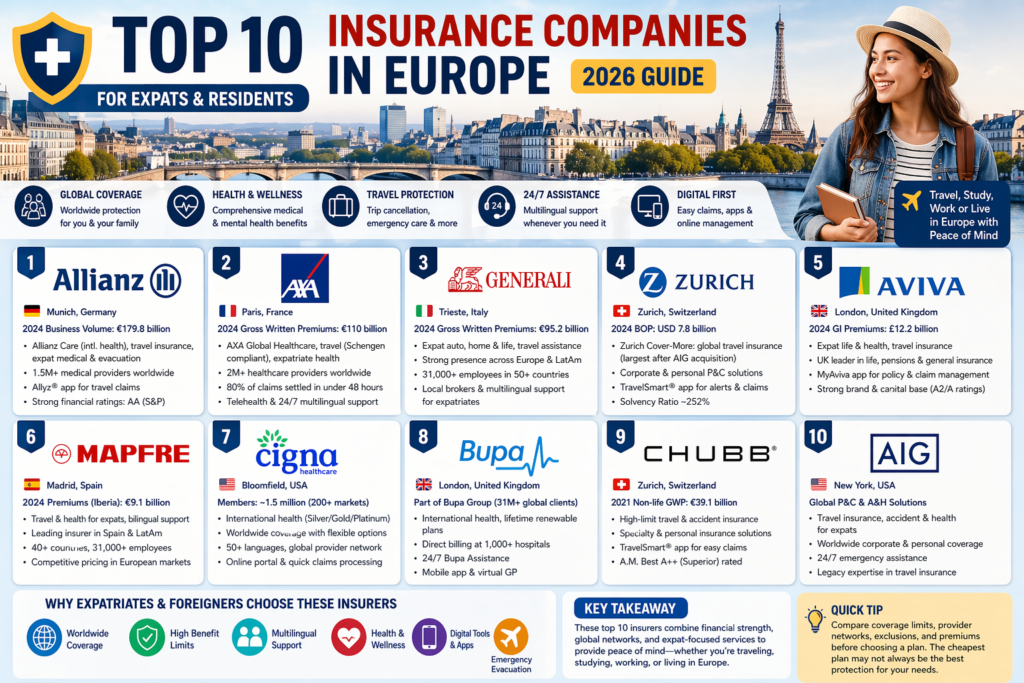
Europe’s insurance sector is dominated by a few global giants. In 2024, Allianz SE (Germany) remained the largest, with total business volume of €179.8 billion. AXA (France) followed with €110 billion and Generali (Italy) with €95.2 billion. This report profiles the top 10 insurers (by premium or global influence) as of 2026, focusing on their appeal to both local residents and foreign nationals/expatriates. For each, we give the headquarters, market ranking metric, key products (especially for expats and foreigners), notable expat-friendly features, premium ranges (when available), digital tools, claims process, and pros/cons. All data is drawn from the latest official sources (annual reports, press releases, regulatory filings, company websites) and reputable market analyses.
The leading companies are global multi-line insurers: life, health, property/casualty, and specialized divisions. Expatriates and foreigners often seek these insurers for international health plans, travel insurance, multilingual support and direct-billing networks. For example, Allianz Care and AXA’s Global Healthcare offer comprehensive worldwide medical insurance with evacuation and virtual care. Travel insurers like Zurich’s Cover-More (post-AIG acquisition) and Chubb provide robust trip coverage. Many maintain 24/7 assistance hotlines, smartphone apps, and online portals for claims. Pricing varies widely by age, location, and plan level – e.g. global health insurance premiums can range from a few hundred to several thousand USD/EUR per year depending on coverage.
Below is an analytical review of each of the top 10 insurers, followed by a comparative table. We also include FAQs, SEO elements (keywords, meta tags, structure, etc.), competitor analysis, and a mermaid timeline of market developments (2020–2026). All figures are current to 2024–2026; where data is unavailable we note “unspecified” or provide context.
1. Allianz SE (Germany)
Headquarters: Munich, Germany. Financial strength: AA (S&P), Aa2 (Moody’s), A+ (AM Best).
2024 Volume: Total business volume €179.8 bn; €82.9 bn in Property/Casualty and €81.8 bn PVNBP (life/health). One of Europe’s top insurers by market share.
Key Products (Foreigners): International health insurance (Allianz Care), global assistance (Allianz Partners travel), expatriate medical plans, global pension plans, emergency evacuation, and repatriation. Allianz Care’s expat health plans cover hospitalization, outpatient care, maternity and dental, plus COVID-19 treatment. Travel plans include medical emergency coverage, trip cancellation, and evacuation.
Key Products (Residents): Standard motor, home, life, health, and commercial insurance. In Germany, offers popular car and home policies; life and retirement products (via PIMCO).
Expat Features: 24/7 multilingual assistance; access to 1.5M+ providers globally (Allianz network); high coverage limits; evacuation & repatriation included. Expat plans include optional outpatient and dental, with pandemic cover. “Care” plans allow adding extras (outpatient, dental) for older expats.
Digital & Claims: Allianz provides the Allyz® mobile app for travel insurance, letting users file and track claims on-the-go by snapping photos of documents. Medical claims (Allianz Care) often use direct billing with providers; many claims (e.g. travel emergency) can be pre-paid by Allianz. Digital policy management via website/app.
Pricing: Premiums depend on age, destination, coverage level. Travel insurance quotes use age and trip cost. International health plans are tiered (e.g. Silver/Gold/Platinum) with prices rising by coverage. (Exact premium ranges vary; typical annual expat health plans run ~€1,000–€6,000 for high coverage in similar markets.)
Pros: Largest insurer in Europe by assets and capital; A+ ratings assure claim payments; very broad global network; leading digital tools (Allyz app); strong brand trust. In travel insurance, Allianz is often top-rated for service.
Cons: Premiums tend to be higher than many competitors due to quality of service. In some local markets (e.g. UK), Allianz has smaller market share than domestic leaders.
2. AXA S.A. (France)
Headquarters: Paris, France. Assets under management €1.4 trn; serves ~93 million clients (globally).
2024 Volume: Gross written premiums and revenues €110 bn, up 8% vs. 2023. Axa ranks #2 in Europe (after Allianz) by premium volume.
Key Products (Foreigners): International private medical insurance (AXA Global Healthcare) for expats and travelers; global travel insurance (AXA Assistance, schengen-compliant plans up to $250k medical); expatriate health with evacuation; international life savings plans; overseas property/motor insurance in some markets.
Key Products (Residents): Health (individual/corporate), motor (auto), home, business/P&C, life & pension, savings, corporate/parametric covers. In France and Europe, known for car/home, health (private top-up to public care), life savings, and SME insurance.
Expat Features: AXA Global Healthcare provides 24/7 telehealth and mental health support, second-opinion services, and guarantees 80% of claims settled within 48 hours. Global health plans offer optional evacuation cover and direct billing via a 2-million-facility network. “Close Care” plans can limit coverage to host/home countries (cheaper). AXA Travel insurance (e.g. Platinum plan) covers Schengen visa needs with high repatriation limits.
Digital & Claims: Most plans allow online claims submission. The AXA app and website provide policy info and claim tracking. Expats can get direct reimbursement or direct-pay at network hospitals. Virtual doctor consultations are available through their platforms.
Pricing: Competitive pricing; Axa advertises “fairly priced plans” balancing cover with cost. Travel insurance (Europe trip) might be €20–€50 per week for a healthy young adult. Expat health premiums vary by age/country (e.g. ~€1,000–€5,000/year for €1–2M coverage limits).
Pros: Very large global reach (51 countries); strong capital base; wide range of products for expats (health, travel, insurance that satisfies visa requirements); fast claim payouts (80% <48h); free 24/7 assistance.
Cons: Customer reviews are mixed (scores ~7.5/10), with some policyholders citing complexity. Expat plans can still be costly compared to local subsidized schemes.
3. Assicurazioni Generali S.p.A. (Italy)
Headquarters: Trieste, Italy. Italy’s largest insurer and #3 in Europe.
2024 Volume: €95.2 bn gross written premiums (+14.9% vs. 2023). Record operating profit of €7.3 bn. Assets under management ~€863 bn.
Key Products (Foreigners): Generali has an international travel and assistance arm (Generali Global Assistance) for trip coverage, medical evacuation, and roadside assistance worldwide. For expats, it offers specialized expat insurance via local branches (e.g. Generali Expatriates in Spain) – bespoke car, home, and life policies tailored to foreigners living in that country. (In Spain, Generali Expatriates serves 150,000+ international clients and has multilingual agents.)
Key Products (Residents): Dominant in Italy’s life and P&C markets (auto, home, casualty). Offers life insurance, savings, pensions, health top-ups (filling gaps of public care), commercial insurance, reinsurance, and asset management. Presence in France, Germany, Austria, Eastern Europe, and global via network.
Expat Features: Multilingual customer support in countries like Spain and France; local expat-focused brokers; simple cash-back offers (e.g. Generali Spain gives €30 back on new car/home policies to expats). They can often pay claims via direct billing at partnered hospitals.
Digital & Claims: Online portals for European customers; Generali Mobile app (in some markets) for policy access. Claim submission can be done via agent or website; Generali Worldwide Assistance provides emergency services globally. The Spanish expat site highlights “dedicated expat brokers” and digital quotes.
Pricing: Generally competitive, especially in local markets. Expat auto/home insurance in Europe (Spain, Italy) may be priced 10–20% above local rates due to risk factors. No public data on premiums.
Pros: Strong pan-European presence and deep local market knowledge; flexible expat offerings in key countries; large capital (A3/A- ratings). Consistent profits and high solvency ratio (~210%).
Cons: Historically less emphasis on digital user interface compared to some peers. Customer service varies by country.
4. Zurich Insurance Group (Switzerland)
Headquarters: Zurich, Switzerland. Chief businesses in Europe, North America, Asia-Pacific.
2024 Highlights: Record Business Operating Profit USD 7.8 bn (up 5%); net income USD 5.8 bn (up 34%). Core ROE 24.6%. Solvency ratio ~252%.
Key Products (Foreigners): Zurich expanded its global travel insurance by acquiring AIG’s personal travel insurance and assistance business in 2024. Under the Zurich Cover-More brand, it now ranks among the largest global travel insurers (market ~USD 20 bn GWP). Zurich offers a range of worldwide travel medical and trip insurance plans for individuals, families, and corporate travelers. It also provides international private health plans (via AXA Partners in some markets) and expatriate car/motor policies in Asia/Europe through partnerships.
Key Products (Residents): Core markets include P&C commercial insurance (General Insurance), Swiss life and pensions (via subsidiary), plus Farmers business in North America. In Europe, Zurich sells car, home, liability, and agricultural insurance.
Expat Features: Travelers benefit from broad multi-trip plans, emergency medical, and repatriation. Corporate clients get global programmes. Zurich pioneered accident insurance for expatriates in some Asian markets. Direct support lines (global assistance) are multilingual. Since 2024, its travel unit (Cover-More) has enhanced multichannel distribution and tech (web/mobile claims for travel).
Digital & Claims: Zurich provides online quotes/policies for travel insurance, with a mobile app for travel and a website portal for GI claims. For GI business, digital platforms and fast digital claims exist (particularly in UK & US). Travel claims can be filed by phone or online. Zurich also integrates data analytics (telematics for auto) to speed up GI claims.
Pricing: Multi-trip travel insurance is often priced by trip cost and age. For example, Zurich Cover-More’s “Infinity” annual plan often costs ~$200–$500/year for a global traveler in his 30s, depending on coverage chosen. Exact health plan prices vary by country and scope.
Pros: Very strong balance sheet and dividend policy (CHF 28/share in 2024); global footprint with expertise in travel/accident insurance; rapidly growing travel division (adds AIG’s book).
Cons: As a Swiss insurer, less focus on emerging markets for retail clients (outside acquisitions). May lack the scale of AXA/Allianz in some European domestic lines.
5. Aviva plc (United Kingdom)
Headquarters: London, UK. ~17 million UK customers (largest insurer in UK).
2024 Results: Operating profit £1.767 bn (↑20%); insurance (GI) premiums £12.2 bn (up ~14%); Solvency II ratio ~203%. Completed acquisition of AIG’s UK protection business in 2024 (growth in health and life lines).
Key Products (Foreigners): Aviva’s focus is primarily on domestic markets (UK, Ireland, Canada) for GI. For expatriates, Aviva offers expatriate life and health policies via partnerships (e.g. HSBC Expat) and some travel insurance. Aviva Travel Insurance provides worldwide coverage for UK travelers, including medical protection and cancellation cover. It also offers financial protection (life/income protection) for Britons living abroad.
Key Products (Residents): Life, pensions, savings, protection, and GI (auto, home, business) mainly in UK and Canada. Also offers retirement annuities and investment products. Acquired UK motor insurer Direct Line in process.
Expat Features: Aviva’s Expat series (via bank alliances) lets citizens secure UK-grade health/life cover overseas. Travel insurance has global medical cover and repatriation. For visa/travel: UK expat plans often include geopolitical evacuation (useful for Middle East postings, etc.). Lifetime renewals on some plans.
Digital & Claims: Aviva’s UK app (“MyAviva”) allows policy management and claims. Online quote/completion for travel and GI. Auto claims can be initiated via mobile with photo upload (UK cars). They are rolling out data-driven underwriting for GI (not expat-specific).
Pricing: Aviva generally prices competitively in UK. Annual travel plans are ~£150–£300 for family coverage (depending on age/destinations). Expat life/health via bank tie-ups may be priced higher, reflecting international cover.
Pros: Strong brand and capital (A2/A ratings). Leader in UK insurance; expanding via acquisitions (AIG UK protection, Direct Line). Integrated platform (life+GI) serves multiple needs.
Cons: Limited direct presence outside UK/Canada (so foreign nationals in other countries may have difficulty buying Aviva products). Historically, slower to innovate digitally than fintech upstarts.
6. Mapfre S.A. (Spain)
Headquarters: Madrid, Spain. #1 in Spain, and large presence in Latin America and Europe.
2024 Results: Net profit €902 million (↑30%). Premiums in Iberia ~€9.1 bn, including €8.7 bn in Spain. Combined Solvency II ratio ~202%.
Key Products (Foreigners): Mapfre’s focus is personal insurance (auto, home, health, travel). It offers specialized international policies for Spanish expatriates (e.g. in Latin America) and local foreigners – for example, Spanish health plans valid in Europe/Latin America. Its travel insurance (via Mapfre Travel) covers Schengen visa needs and global trips. It also has global reinsurance and specialty units.
Key Products (Residents): In Spain: leading in auto, home, life & pensions, and health. In Latin America: significant player (Brazil, Mexico, Chile, etc.) in life and P&C. In Western Europe: operations in Germany, Portugal, US (via U.S. unit).
Expat Features: Bilingual service (Spanish/English); tailored products for Hispanics abroad. Provides local offices in 40+ countries; over 31,000 employees globally. Offers multi-trip travel policies with high coverage limits, and expat car/home policies under its Generali-Allianz network in Europe.
Digital & Claims: Mapfre Spain offers a well-developed online portal and mobile app for quotes and claims. Claims can be initiated online or via app (documents upload). In Latin America, e-claims and telematics devices are used.
Pricing: Competitive in European markets. In Spain, travel insurance is about €10–€30 per week for standard plans. Expat health policies (e.g. Latin America-based) vary widely.
Pros: Strong in Spanish-speaking markets; extensive Latin American network; multilingual support. High Spanish market share (leading insurer). Good financial solidity (profit and Solvency ratio rising).
Cons: Less well-known outside Spain/LatAm, which can deter non-Spanish expats. Global health/ travel offerings are not as widely marketed as those of AXA/Allianz.
7. Cigna Global (United States)
Headquarters: Bloomfield, Connecticut, USA (Cigna Corp). Cigna acquired Aetna in 2021 (but “Cigna Global” is the international arm).
2025 Status: ~1.5 million international members, operates in 200+ countries. Cigna Global is widely sold via brokers and employers.
Products (Foreigners): Cigna’s flagship is international private medical insurance for expats (Silver/Gold/Platinum plan levels). Plans cover inpatient, outpatient, mental health, maternity (higher tiers), with annual limits up to $2M or unlimited. They also offer captiveCare for clients in the US, and group health plans for multinational companies.
Products (Residents): Limited – Cigna’s focus is global expat and international markets. In the US it’s a major HMO/PPO, but in Europe it operates only through its global unit (no domestic P&C or life).
Expat Features: 24/7 customer service in 50+ languages. Broad choice of providers (online directory); direct billing at many facilities. Flexible cover: ex-USA option (cheaper) or full global including the US. Coverage “travels” with the client (covers multiple countries). Wellness programs and telemedicine are included on all plans.
Digital & Claims: Cigna provides an online member portal and mobile app to manage claims and ID cards. Claim turnaround is typically 5–15 business days after submission. They emphasize e-payments and electronic claim submission for speed.
Pricing: Varies by age, country and plan. Example: a 40-year-old living in Europe might pay ~$2,000–$3,000/year for Gold cover with $1–2M limit; younger individuals pay less. Pricing is generally higher than regional insurers because plans are global in scope.
Pros: Specialized global insurer – large multilingual network. Plans are highly customizable. Strong for high-net-worth or corporate clients needing worldwide cover.
Cons: Generally among the most expensive international health plans. Requires brokers for purchase (no direct sales). Outside health, Cigna has no travel or other consumer insurance offerings.
8. Bupa Global (United Kingdom)
Headquarters: London, UK (originally British United Provident Association). Part of Bupa Ltd (UK).
Products (Foreigners): Bupa Global offers international private medical insurance plans with lifetime renewal and large direct-billing networks. Plans (Elite, Premier, etc.) cover inpatient, outpatient, maternity, evacuation, and dental (add-on). Dedicated expatriate plans adjust coverage to residence country. They also provide Bupa Global Travel (formerly International Health Insurance), and assistance services.
Products (Residents): In UK/Europe, Bupa is a major health insurance provider (UK private health insurer). They do not offer car/home insurance. Outside health, not a global P&C player.
Expat Features: Direct-billing in Bupa’s network of 1,000+ hospitals worldwide; 24/7 Bupa Assistance for emergencies. All plans include worldwide cover with optional exclusion of USA. No lifetime limit on claims (a rare feature). Mental health support and second opinions (via AXA’s ties) are included.
Digital & Claims: Bupa Global app lets members view coverage and claim status. Claims usually paid within 7–10 days. They have health assessment tools (MyHealth portal) and virtual GP services. Many providers allow direct billing, simplifying the claim process.
Pricing: Premiums are high: a healthy 30-year-old might pay ~$1,200–$2,000/yr for Basic global cover, several thousand for Elite-level. No-substance clauses often apply (no cover for pre-existing conditions).
Pros: Renowned for service quality and claims reliability. Lifetime cover gives policyholders peace of mind. Bupa’s large scale (serving 31M customers globally) ensures stable finances.
Cons: Among highest-cost providers. Only medical insurance (no life/travel). Some clients report slow international provider reimbursements if paperwork is missing (though rare).
9. Chubb Ltd. (Switzerland)
Headquarters: Zurich, Switzerland (Chubb is the global P&C company; owned by US-based ACE/Chubb corp).
Ranking: 4th-largest European non-life insurer by 2021 GWP (€39.1 bn). Chubb is a top 10 European insurer overall.
Products (Foreigners): Chubb is known for high-limit global travel and accident insurance, personal lines, and specialty P&C. For foreigners, Chubb offers premium travel plans (e.g. “OneTrip” series for US travelers) and accident/hospital plans for expats (especially Asia). It also underwrites expatriate property/motor risks for corporations.
Products (Residents): Offers auto, home, small commercial (via Chubb Insurance in UK), and large corporate insurance. In many European markets it operates through Lloyd’s syndicates or partners (France, UK, etc.).
Expat Features: 24/7 emergency assistance globally. Many Chubb travel plans include unlimited emergency medical evacuation, up to $1M medical coverage, and concierge services. Their catastrophe response for expats in disaster zones is highly rated.
Digital & Claims: Chubb’s TravelSmart® mobile app provides real-time travel alerts, trip itineraries and claim initiations. Claims can be filed via app, online or phone. Electronic claims handling and AP to providers are available in major networks.
Pricing: High-end. E.g. OneTrip Prime (Trip cancellation+ medical) might cost ~$50–$100/week of travel for older travelers (mostly US data). Chubb’s expat accident plans are usually bespoke-priced.
Pros: Top-tier cover limits and speed. A.M. Best A++ rating; known for excellent claims handling. Strong in niche high-risk areas (yachts, fine art, etc.).
Cons: Niche/complex products mean less focus on cheap, mass-market insurance. In standard markets (mass auto/home) Chubb is smaller than omnipresent local insurers.
10. American International Group (AIG, USA)
Headquarters: New York, USA (primary; listed also in Europe). Formerly one of the world’s largest insurers.
Products (Foreigners): AIG was long known for travel and expatriate insurance. As of 2022–2024, AIG’s personal travel insurance book was sold to Zurich/Chubb as noted below, but AIG still offers corporate P&C globally. Individual products now (AIG label) include travel insurance, accident & health (for multinational companies and expats), and affinity products (life/health through partnerships).
Expat/Foreigner Features: Prior to acquisition, AIG’s travel insurance included up to $800,000 medical cover and virtual care. Their global A&H plans have extensive evacuation and a worldwide provider network. AIG brokers often emphasize 24/7 support and few coverage restrictions.
Digital & Claims: Had mobile claims apps for travel; post-sale, Zurich Cover-More took over these functions. AIG still offers online claims for their remaining products; corporate A&H claims may use third-party administrators.
Pricing: Was medium-to-high (e.g. AIG’s OneTrip travel plans priced similarly to Allianz/Generali).
Pros: Historically innovative (first travel insurance, early evacuation cover). Now part of Zurich’s massive travel division, so its legacy offerings have broad support.
Cons: Legacy AIG brand (during 2008 crisis) may lack the current cachet of AXA/Allianz/Zurich for retail consumers. Many retail personal lines have been divested.
Comparison Table – Top 10 European Insurers (2026)
| Company | HQ (Country) | 2024 Scale (GWP or Rank) | Foreigners/Expats Focus | Residents Focus | Digital & Claims |
|---|---|---|---|---|---|
| Allianz SE | Munich, Germany | Business €179.8 bn (2024) (Europe’s largest) | International Health (Allianz Care), Travel (Allianz Partners), Evacuation | P&C (auto, home), Life & Savings, Reinsurance | Allyz app for travel claims; telehealth; online claims portal |
| AXA SA | Paris, France | GWP €110 bn (2024) (Europe #2) | Global Healthcare (telehealth, mental health), Travel (Schengen-compliant plans) | Motor, Home, Life, Savings, SME Insurance | Virtual doctor, 80% claims paid <48h; online quoting/claims |
| Generali | Trieste, Italy | GWP €95.2 bn (2024) (Europe #3) | Travel/Medical Assistance (via Generali Global Assistance); Expat auto/home/life via local brands | Life & Pensions, Property/Casualty (Italy, France, etc.) | Local apps in markets; direct-billing networks; digital agent support |
| Zurich Ins. | Zurich, Switzerland | BOP USD7.8 bn (2024); acquired AIG Travel | Global travel insurance (Zurich Cover-More, largest travel insurer after AIG deal) | P&C Commercial, Swiss Life/Pension (Europe), Farmers (US) | TravelSmart® app (itineraries, claims); online GI platforms; fast e-claims |
| Aviva plc | London, UK | GI premium £12.2 bn (2024); 17M UK customers | Expat life/health (via HSBC etc.); International travel plans | UK Life, Pensions, GI (motor, home, biz); Canada GI | “MyAviva” app; online claims and quoting in UK; telematics in GI |
| Mapfre SA | Madrid, Spain | Net profit €902 m (2024); Premiums €9.1 bn (Iberia) | Latin America/EU bilingual travel and health plans | Auto, Home, Life, Health (Spain/Portugal), LatAm GI | Mapfre+ app (Spain); online quotes/claims; Latin America e-portal |
| Cigna Global | Bloomfield, USA | ~1.5M members; present in 200+ markets | International Health Insurance (Silver/Gold/Platinum plans) | – (no domestic P&C) | Online portal; claims in 5–15 days; global 24/7 support |
| Bupa Global | London, UK | – (part of Bupa plc, 31M global clients) | International Health (lifetime cover); Global Travel insurance | Private health (UK/Europe) | Mobile app; direct billing network; lifetime renewable plans |
| Chubb Ltd | Zurich, Switzerland | Non-life GWP €39.1 bn (2021) | Global Travel & Accident Insurance; High-end P&C | Commercial and personal insurance in Europe | TravelSmart® app (alerts, claims); fast payout for travel/accident |
| AIG | New York, USA | – (legacy insurer; travel arm now Zurich) | International Travel (formerly under OneTrip brand) | Large Commercial P&C globally | Prior apps/portals for travel; Zurich now handles most consumer claims |
Each insurer offers distinct strengths: Allianz and AXA lead in breadth and financial might; Generali excels in integrated European offerings; Zurich is the travel/assistance expert; Aviva and Mapfre dominate their home markets; Cigna and Bupa specialize in expat medical cover; Chubb provides high-limit global P&C; and AIG’s legacy travel business now continues under Zurich.
FAQs
Which insurer is best for expats in Europe?
Leading choices include Allianz (Allianz Care expat health, Allianz Travel insurance), AXA (AXA Global Healthcare, AXA Assistance travel), Cigna and Bupa (specialized global health), and Zurich Cover-More (travel insurance). The “best” depends on your needs (health vs. travel vs. life), country of residence, and budget. All offer online quotes and expatriate plans.
What factors determine premiums for expat insurance?
Age, country of residence (cost of healthcare there), coverage limits, and included services are key. Plans often exclude pre-existing conditions, which can raise cost. For travel insurance, trip length and destination matter; for health insurance, excluding the USA lowers premium. Digital quote tools (on insurer sites) illustrate how rates vary.
How do I claim on international insurance?
Most offer online/mobile claim submission. Many expat health plans have direct billing (providers are paid directly by insurer). Travel insurers typically require receipts for reimbursement. Apps (e.g. Allianz’s Allyz, Chubb’s TravelSmart) speed up emergency claims.
Are private plans required for foreigners in Europe?
Long-term visas often require proof of health coverage. Some countries allow expats into public systems, but even then private plans are popular for extra benefits (dental, outpatient, shorter wait times). All ten companies above either directly provide or partner with brokers to supply these expatriate-required plans.
How do digital services compare?
Most top insurers now have user-friendly apps/portals. Allianz’s Allyz® app and Zurich’s TravelSmart® app are industry-leading for travelers. AXA Global Healthcare and Bupa have robust online portals for expat medical claims. Insurers also use telehealth and AI chatbots to improve responsiveness. Ensuring quick online support and claim tracking is a common advantage at these insurers.
thanks