
Cheap health insurance for international students USA 2026 is essential to avoid extremely high medical costs while studying abroad. Providers like IMG Global, WorldTrips, and ISOA offer affordable plans starting as low as $30 per month. This guide to cheap health insurance for international students USA 2026 covers visa rules, plan types, pricing, and tips to find the best coverage.
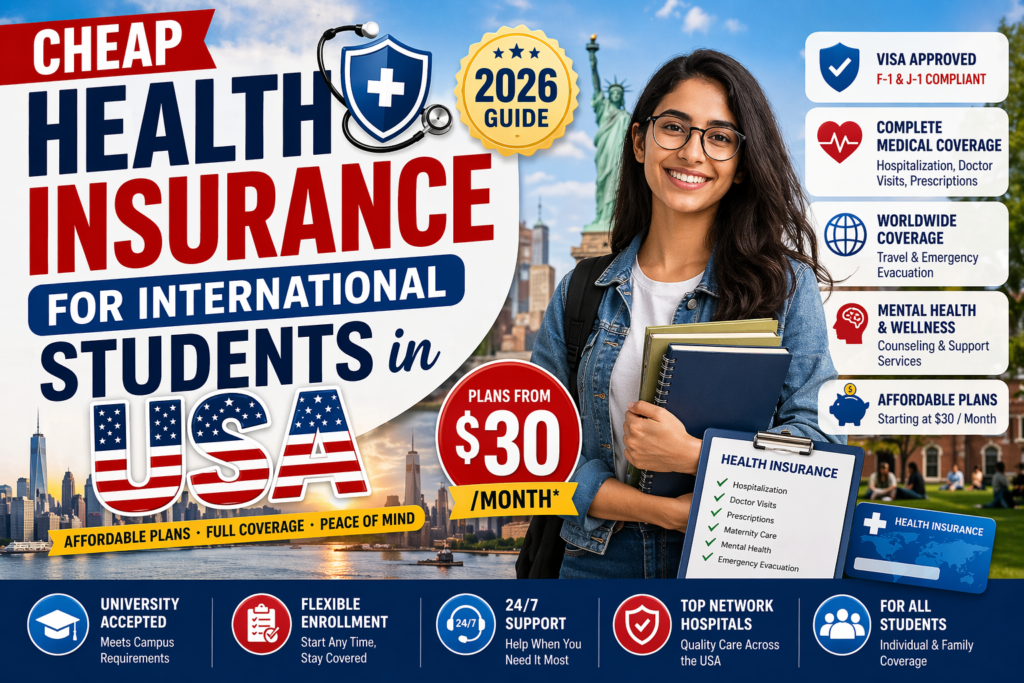
International students in the U.S. face very high medical costs, so finding affordable health insurance is critical. In 2026, F-1 and J-1 students must navigate visa requirements (J-1 mandates insurance with $100K+ benefits, F-1 has no federal mandate but most universities require coverage). Typical student health plans include benefits like hospitalization, mental health, and evacuation, and can cost roughly $30–$60 per month for young students (ages ~20). University-sponsored plans often run $1,500–$3,500 per year, whereas private international student plans start around $360–800/yr. This guide covers the latest 2026 info on cheap health insurance for international students: visa and campus mandates, plan types (university, private, travel), coverage features, price ranges, enrollment tips, and a comparison table of budget-friendly plans. We also provide SEO-friendly structure, FAQs, and a flowchart of enrollment steps for clarity.
Why Health Insurance Is Essential for International Students
The U.S. has no universal healthcare, so health costs can be astronomical. A simple doctor’s visit can become an “insurmountable expense” without insurance. Hospitals often require payment upfront if you’re uninsured, and even minor issues can run into thousands of dollars. For example, without insurance a basic ER visit might cost $1,500–$5,000, whereas covered patients pay copays. International student health insurance is tailored to cover study and travel needs. It typically includes core benefits (hospitalization, doctor visits, prescriptions) and student-specific add-ons like mental health, sports injuries, maternity, emergency evacuation, and repatriation. Student plans can be renewed monthly up to four years. These plans differ significantly from short-term travel insurance: travel policies often cover only emergencies and have strict trip durations. By contrast, student plans provide ongoing care during semesters. In summary, even if you plan to stay healthy, having basic compliant insurance is mandatory or strongly recommended by campuses to ensure you won’t face crippling medical bills. Always compare benefits and network access, not just the sticker price, when choosing a plan.
Visa and University Requirements
J-1 Exchange Visas (Students and Scholars)
U.S. J-1 visa programs have formal federal insurance requirements. You must maintain coverage for the entire exchange period with at least $100,000 per accident/illness, $25,000 for repatriation of remains, and $50,000 for medical evacuation, with deductible ≤ $500. (Dependents on J-2 visas have identical requirements.) Most student insurance plans (e.g. ISI’s Student Secure or IMG’s Journey) are designed to “meet and exceed” these limits. Check that your chosen plan explicitly satisfies the J-1 criteria listed by the U.S. Dept. of State.
F-1 and Other Student Visas
The U.S. government does not mandate health insurance for F-1 or F-2 students. However, virtually all U.S. colleges and universities require that international students have health insurance. This ensures students can access care and not default on campus charges. If your school offers a Student Health Insurance Plan (SHIP), you may enroll in it or waive it by showing you have an equivalent private plan. Waiver criteria typically demand coverage of ACA-required benefits (preventive care, prescription drugs, mental health) and limits like unlimited or very high maximums, deductible ≤ $500, and out-of-pocket max ≤ about $8,000. Some universities publish their specific waiver standards (for example, Kansas requires unlimited benefits, mental health, and $100k+ evacuation). Reminder: While F-1 students have no visa mandate, going uninsured is risky: many schools won’t register you without proof of insurance, and “even a minor medical issue can become very expensive”. International students are exempt from the ACA individual mandate penalty (first 5 years of visa status), but note that F-1 students generally cannot buy subsidized marketplace plans. In practice, most F-1s either use the school plan or a private student plan (see below).
University Mandates and ACA
Most institutions auto-enroll international students in the campus health plan by default. For example, UConn’s fall plan starts August 1 and covers students regardless of health, but allows waivers. If waived, any alternative plan must match UConn’s “ACA-level” criteria. (Some state or federal ACA rules may technically apply, but since F-1/J-1 students are excluded from public subsidy, the main driver is the school.) In summary, treat school deadlines and waiver rules as firm requirements. Check your university’s International Student Office website early to see if you must buy the school plan or if you may use an outside plan that meets their specs.
Types of Student Insurance Plans
International students in the U.S. can choose from several plan categories:
- University-Sponsored Plans (SHIP): Offered directly by your college, often through insurers like UnitedHealthcare or BlueCross. These plans usually meet all campus requirements and may include generous benefits (no coverage caps, campus clinic included), but they can be expensive (often $1,500–$3,500 per academic year). Waiving these plans is possible only with a comparable alternative.
- Private International Student Plans: Tailored for students, these plans (from providers like ISOA, IMG, WorldTrips/Atlas, AXA-PPP) mimic SHIP benefits but at lower cost. They typically use U.S. PPO networks (e.g. UnitedHealthcare PPO) and include specialized coverages like sports injuries and mental health. For example, ISOA’s silver plan starts at $31/month with ~$400K max. These plans are renewable per semester or year and cover you worldwide (not just in your school state).
- Short-Term Travel Plans: Some students (especially those on short exchange programs) opt for travel insurance (e.g. IMG “Atlas Travel”, HTH). These plans are cheaper and can be bought by the week or month, but usually only cover emergencies and may not satisfy university waivers. As a rule: travel insurance is for trips, not for full-degree study.
- ACA/Marketplace Plans: In rare cases (some states allow it), an international student may buy an ACA “Obamacare” plan. However, note that non-citizens on visas typically can’t get subsidies, and ACA open enrollment is limited (plus coverage can lag). Given the complications, this option is uncommon for F-1s.
Key Features of Student Plans: Unlike general travel insurance, student-focused plans often include coverage for pre-existing conditions (after a waiting period), maternity care, mental health, and even leisure sports. Premiums are age-based: younger students (under 25) generally pay the least. Many plans offer monthly renewal up to 48 months. Make sure any plan you pick has at least the minimum benefits your school and visa require (especially for J-1 holders). See the comparison table below for examples of budget-friendly plans.
Typical Costs, Coverage, and Enrollment Windows
Premium Ranges: According to insurers, a healthy student under 25 can find U.S.-coverage plans for roughly $30 to $150 per month, depending on coverage limits. For instance, WorldTrips’ StudentSecure Smart plan is about $32/month, and IMG’s Student Journey Lite is about $30/month (both for a 20-year-old). For context, Student-Insurance.com notes that U.S. student plans often cost $500–$800 per year (about $42–$67/mo), whereas university plans cost on the order of $1,500–$3,500/year ($125–$292/mo). Table 1 below compares 6 affordable plans (all meet F-1/J-1 requirements) showing monthly premiums and key features.
Coverage Levels: Cheap plans trade off lower caps or higher deductibles. For example, an entry-level plan might have a $400K annual max with a small deductible, whereas a higher-tier plan might offer unlimited max benefits. Deductibles on cheap student plans often range $0–$500. Note, however, that a higher deductible can drastically cut your premium (as long as you’re healthy). Always check if key coverages (mental health, medications, maternity, emergency evacuation) are included; many plans in our table do include these.
Enrollment Windows: One advantage of student plans is flexibility. Private plans can typically be purchased any time of year and start on a date of your choice (often up to 6 months ahead). University plans, by contrast, are usually bound to semester start dates (e.g. Fall coverage from August 1 and Spring from January 1). You can buy coverage after arrival, but it’s strongly recommended to have insurance in place when classes begin. Many schools require proof of coverage by registration deadlines.
Enrollment Steps: Generally, the process is:
- Check Requirements: Review your visa (J-1 vs F-1) and university insurance rules.
- Compare Plans: Use our table or insurers’ sites to find plans that fit your needs/budget.
- Purchase Plan: Complete an online application and pay premium (plans often allow monthly or annual payment).
- Get Proof: Obtain a certificate or ID card showing your coverage.
- Submit Waiver (if applicable): If you waive a school plan, submit your policy to the international office for approval.
Comparison of 6 Affordable Student Plans
| Plan Name (Insurer) | Monthly Premium (approx.) | Deductible | Coverage Highlights | Eligibility | Source/Buy |
|---|---|---|---|---|---|
| Student Journey Lite (IMG Global) | ~$30/mo | $100 | $400K max; $150K/illness; includes ER, Rx, maternity; 6-mo pre-existing wait | F-1, M-1, J-1 | IMG (AmericanVisitor) |
| StudentSecure Smart (WorldTrips) | ~$32/mo | $0 | $200K max; $100K/illness; covers ER, mental health, evacuation; 25K sudden pre-existing | F-1, J-1 | WorldTrips (AVisitor) |
| Student Journey Plus (IMG) | ~$48/mo | $500 | Unlimited max; $300K/illness; adds mental/sports, maternity | F-1, M-1, J-1 | IMG (AVisitor) |
| StudentSecure Budget (WorldTrips) | ~$53/mo | $0 | $500K max; $250K/illness; includes sports, maternity; 12-mo pre-existing | F-1, J-1 | WorldTrips (AVisitor) |
| ISO Silver Plan (ISOA) | ~$31/mo | $45 (student clinic); $100 (other) | $400K max; $150K/illness; covers ER ($350 copay), evac $60K, repatriation $50K | F-1 (all ages) | ISOA |
| Patriot Exchange (ISI) | ~$75/mo | $0–$500 (options) | $5M max; $50K–$500K/illness; includes UHC network, 90% coinsurance; meets all J-1 requirements | F-1, J-1, dependents | ISI (Patriot) |
Tips for Saving Money on Insurance
- Higher Deductible: Choosing a plan with a higher deductible can cut your premium substantially. If you’re young and healthy, paying up to $500 out-of-pocket before benefits kick in may be worth the $10–$30 monthly saving.
- Annual Payment: Many insurers give a discount if you pay yearly instead of monthly. The table rates show annual cost as ~12× the monthly; often the actual one-year price is 5–10% lower than 12 monthly payments.
- Student Health Center: Use your campus health clinic for low copays. Plans often have a small co-pay for student health center visits (e.g. $25–$45).
- Compare Plans: Don’t just accept the default. Use brokers or comparison sites (like StudentInsurance.com or AmericanVisitorInsurance) to see multiple plans side by side. Even if a school mandates insurance, ask if alternative plans can be waived.
- Avoid Overcoverage: Only buy necessary add-ons. For example, if you don’t play extreme sports, skip the sports rider. Optional benefits cost extra. The plans in Table 1 are lean on add-ons but meet standard visa/school requirements.
Frequently Asked Questions
- Q: Is health insurance mandatory for F-1 students?
A: The U.S. government does not legally require F-1 students to have insurance. However, most U.S. universities do require it. They will either enroll you in their plan or expect proof that you have an equivalent policy. In practice, you will need insurance to register for classes. Without it, even a minor illness could cost thousands out-of-pocket. - Q: When should I enroll or buy a plan?
A: You can buy anytime, but ideally secure coverage before classes start. University plans typically enroll new students at the beginning of each term. Private plans can start on any date. Many students purchase a plan while applying for their visa or as soon as they confirm admission. If you arrive without insurance, buy immediately; campuses often won’t allow fall enrollment without proof of a plan. - Q: Do these plans cover internships, CPT/OPT, or study abroad?
A: Yes. Most student plans remain valid during CPT/OPT and approved internships, as long as your visa status is active. They often cover travel outside the U.S. for short trips (unlike university plans). However, if you leave the U.S. for long periods, check the plan’s terms. - Q: What if I skip insurance and rely on my family’s plan from home?
A: Most foreign health plans have no coverage in the U.S. Many U.S. hospitals will require cash payment upfront from an uninsured patient. University health centers and hospitals typically demand proof of domestic insurance or payment. Additionally, some visa types (e.g. J-1) legally require U.S.-valid coverage. It’s safest to buy a student plan that covers you in the U.S. - Q: How do I compare or find the cheapest plan?
A: Don’t chase just the lowest premium; check coverage limits and deductibles. A $30/mo plan might have lower caps, so compare what you get. Tools like the American Visitor Insurance website or StudentInsurance.com let you compare multiple plans in minutes. In our table above, plans start as low as $30–$32/mo for basic coverage, up to $50–$60 for more comprehensive coverage. Always ensure the plan “meets your university and visa requirements”, even if you choose a budget option.