
Business loans for non US citizens can still be secured in 2026, but it requires careful planning. In recent years, federal rules changed: as of March 2026 the U.S. Small Business Administration (SBA) no longer backs loans for any business partly owned by non-citizens. This ban now excludes green card holders as well. Even so, entrepreneurs with valid visas or green cards have options outside the SBA. Community banks, fintech lenders, microloan providers, and private investors will still consider foreign-owned small businesses. In this guide we explain who qualifies, which lenders to try, what paperwork you need, and step-by-step how to apply. By following these actionable tips, immigrant business owners can find funding in 2026 despite the SBA restrictions.
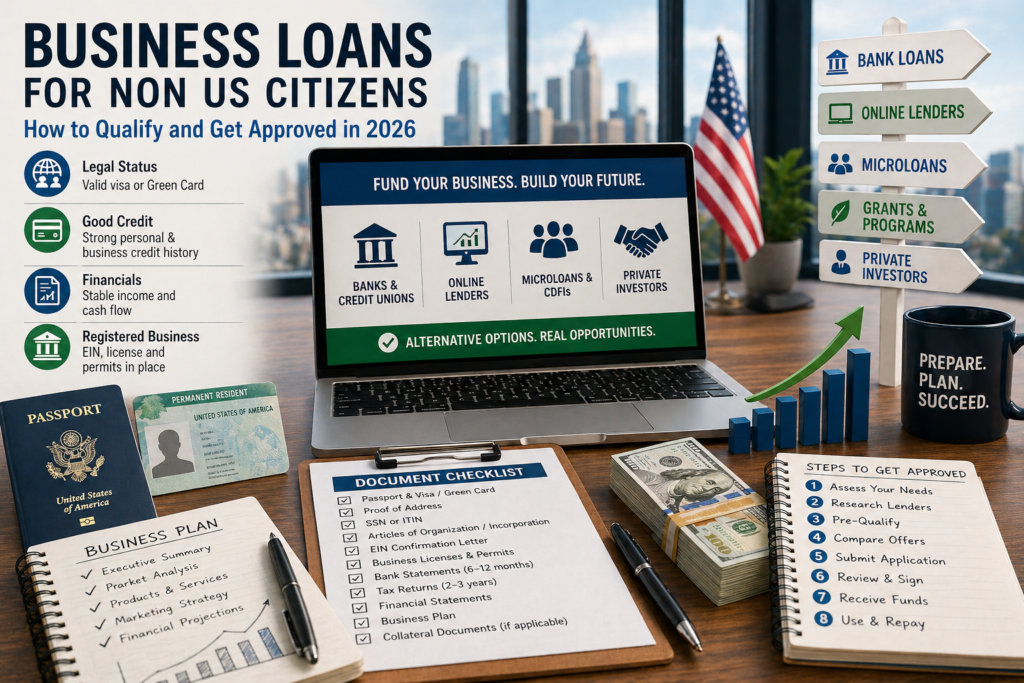
Eligibility: Who Qualifies for a Business Loan?
Not everyone can get a loan – lenders check immigration status, credit history, and finances.
Visa or Residency: You must be legally in the U.S. on a valid status (H-1B, L-1, O-1, E-2 investor visa, etc.) or be a permanent resident. Important: SBA loans now require 100% U.S. citizen ownership, so non-citizen owners must turn to other lenders. Banks and credit unions typically require at least 1–2 years in business and an established U.S. credit history. Foreign entrepreneurs should be prepared to show a work permit or visa that allows business activity. (See LendingTree – you don’t need a U.S. SSN, but you do need an ITIN or SSN to form your company.)
Residency/Paperwork: Lenders will ask for government ID and immigration documents. Have your passport plus visa or Green Card ready, and proof of U.S. address. You may also need an SSN or an ITIN (tax ID) – credit applications require one.
Credit and Income: Expect a thorough review of your credit scores (U.S. credit score or international credit check) and income. Many lenders want at least “good” credit. Bankrate advises submitting one year of personal and business bank statements and three years of tax returns to show your cash flow.
Business Qualifications: Most lenders require your business to be formally registered (LLC, Corp, etc.) with an EIN (Employer ID). The IRS requires an SSN or ITIN to issue an EIN. You’ll also need licenses/permits (sales tax certificate, professional license, etc.) depending on your industry.
Top Lenders and Financing Options
With SBA-backed loans off the table for non-citizen owners, consider these alternatives:
Banks & Credit Unions: Large banks (Chase, Bank of America, Wells Fargo) offer business term loans and lines of credit. They usually require 2+ years in business, collateral, and strong credit. Some will work with visa-holders or LPRs if documentation is solid. Credit unions and community banks may be more flexible on immigration status.
Online Lenders/Fintech: Companies like LendingClub, Kabbage, BlueVine, Fundbox, OnDeck, and QuickBooks Capital provide quick small-business loans or credit lines with minimal paperwork. For example, LendingClub’s platform approves loans to U.S. citizens, permanent residents, or long-term visa holders, and has loans up to $40,000. SoFi offers personal and business loans to H-1B, E-2, L-1 visa holders (and other visa types). These lenders often require a U.S. bank account and a business in good standing.
Peer-to-Peer or Investor Loans: P2P platforms match you with individual or institutional investors. They have similar criteria to online lenders. Rates and terms vary widely.
Community Development Financial Institutions (CDFIs) and Nonprofits: These mission-driven lenders offer microloans ($500–$50,000+) at low interest to underserved borrowers, including immigrants. Examples include organizations like Accion, Opportunity Fund, or local groups (some serve specific cities or populations). These loans often come with business coaching. For instance, one CDFI offers loans from $500–$35,000 for refugee and immigrant entrepreneurs.
Grants and Subsidies: Look for state or local immigrant entrepreneur programs. For example, the U.S. Dept. of Treasury’s Community Programs or state commerce departments may offer grants or subsidized loans. (While not loans, grants are helpful free funding if eligible.)
Peer Groups and Crowdfunding: Non-traditional sources like Kiva (0% interest microloans) or crowdfunding campaigns (Kickstarter, GoFundMe) can sometimes fund immigrant startups.
Each lender type has pros and cons. Traditional banks have lower rates but stricter rules; fintech lenders are fast but may charge higher fees. With the SBA ban, “entrepreneurs can look to state-funded options, community development financial institutions, lending circles and impact investors for alternative sources of capital”.
Required Documents and Checklist
Preparation is key. Gather these items before applying:
- Personal Identification: Valid passport and U.S. visa or Green Card. Some lenders ask for an unexpired driver’s license too.
- Proof of U.S. Presence: Utility bill or lease showing a U.S. address.
- Tax ID: Social Security number or ITIN (needed for credit checks).
- Business Formation: Articles of incorporation/organization, operating agreement (for LLC), or partnership agreement.
- Licenses and Permits: Any required business licenses or permits (city, county, state).
- EIN Confirmation: IRS letter with your Employer ID number.
- Financial Records:
- Personal and business bank statements (usually past 6–12 months).
- Business financial statements: profit/loss, balance sheet, cash flow projections (if available).
- Recent tax returns (personal and business, 2–3 years).
- Accounts receivable or inventory lists, if relevant.
- Business Plan: A concise business plan or loan proposal. This should include an executive summary, how you’ll use the funds, and repayment plan. (Lenders often request this before approving a loan.)
- Collateral Documents (if needed): Appraisal or title for any collateral you pledge (real estate, vehicles, equipment).
- Personal Background: Resume or proof of industry experience (especially if it’s a startup).
- Miscellaneous: Reference letters or contracts, if applying for certain loans, and a signed loan application form.
Following this checklist shows lenders you’re organized. For example, Bankrate emphasizes having your business licenses, articles, EIN and up to a year of statements ready. Wise also notes you’ll need passport + visa, proof of address, SSN/ITIN, and income proof.
Step-by-Step Application Guide
Identify Your Loan Need: Decide how much money you need and for what purpose (startup costs, inventory, equipment, expansion, etc.). This will guide which loan or lender suits you.
Research Eligible Lenders: Based on your business age and your visa status, shortlist lenders that serve non-citizens. For instance, if you have 2+ years in business, a bank or SBA-partner might consider you (if fully US-owned). If you lack history, look at online lenders or CDFIs.
Pre-Qualification: Many online lenders allow free pre-approval checks with a soft credit pull. Submit basic info (name, SSN/ITIN, revenue) to get estimated rates or terms. As Wise recommends, first “enter some personal details… to generate an instant quote or pre-approval”.
Compare Offers: Review offers from several lenders. Compare interest rates, fees, loan term, repayment structure, and conditions (like personal guarantee). Choose the loan that best fits your needs.
Complete Formal Application: Fill out the lender’s application form and upload all required documents from the checklist above. Some lenders may require an in-person meeting or notarized copies.
Review Terms and Sign: Once approved, the lender will send loan documents. Read them carefully (interest rates, fees, payment schedule) and sign if acceptable.
Receive Funds: After signing, funds are typically deposited in your business account. Wise notes that once approved, “the funds will be deposited into your bank account directly”.
Use Funds and Repay: Use the loan for the intended business purpose, and make payments on time to build credit. Some lenders may also require periodic financial updates.
Keep these tips in mind: Be truthful on your application, respond promptly to lender requests, and ask if a co-signer (like a U.S. citizen friend or family member) can help improve your chances. Even after rejection, ask the lender for reasons (like credit issues) so you can address them.
Special Programs and Alternatives
Beyond loans, consider grants or community programs:
State/Local Grants and Loans: Some states/cities have entrepreneurship funds aimed at immigrants or minorities. For example, refugee microenterprise grants can provide small start-up funds (often under $15,000) and training.
Community Funding: Organizations like SCORE or local Chambers of Commerce offer free business counseling and may direct you to funding resources.
Peer Groups: Groups like credit unions or savings & loans associations sometimes offer “foreign national loans” with special terms (though often for mortgages, some have small business programs).
Friends/Family or Personal Loans: As a last resort, consider borrowing from family or taking a secured personal loan against your assets. Ensure any loan is legal and documented.
Despite the challenges, remember that successful small business owners can and do get funded without U.S. citizenship. With the SBA’s changes, “conventional bank loans, lines of credit, private financing, or alternative lending sources may need to be explored” for non-citizen business owners. Stay organized, work with experienced lenders, and use the above checklist and steps. Over time, by building credit and business history, you’ll expand your financing options even more.